As a group we explore the entanglement of human and non-human entities when walking with pain. This has included investigating the potential and possibilities of responsive methods where walkers were initially filmed by academic partners who also asked reflective questions about the relationship between walking, pain and landscape.
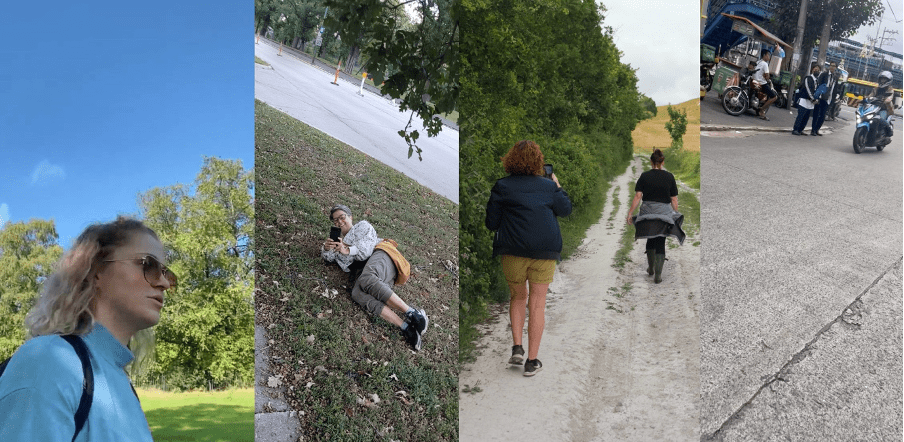
Documenting Sites, 2023.
Photographers: Roger Kerry; Jeni Ross; Shirley Chubb; John
Various approaches were taken to documenting walker partners in their landscapes
As a group we explored the potential and possibilities of responsive methods where walkers were initially filmed by academic partners who also asked reflective questions about the relationship between walking, pain and landscape.
As the project grew, walker partners became confident in filming independently, and the team as a whole recognised how each environment revealed new assemblages of landscape-pain-response-time-rural-urban-cultures. As the recordings developed, researchers and walkers discussed initial test edits and the questions each film prompted. This led to further edits in order to capture and communicate the breadth of relationships between walkers and place.
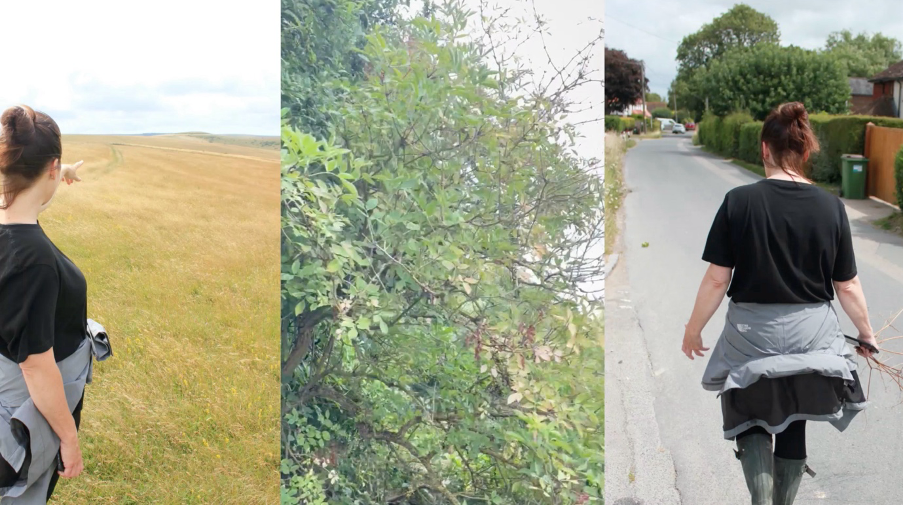
Walker Partner Fe Stevens, UK. Project Film Still, 2023
Photographers: Shirley Chubb & Clair Hebron
Initial footage involved researchers documenting walker partner
Click here to listen to Fe’s reflections on her experience of taking part in the PWP
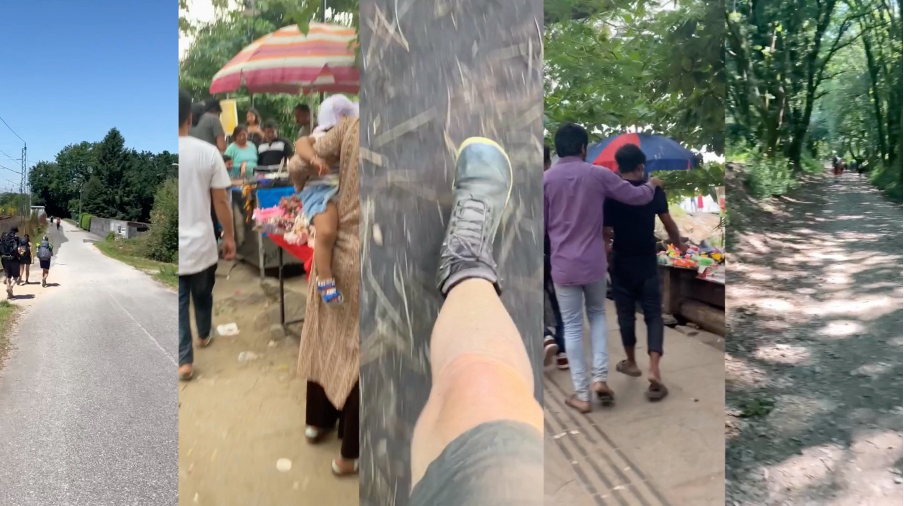
Walker Partner Branwen Lorigan, UK. Project Film Still, 2024
Photographer: Branwen Lorigan
Branwen documented her walks across the Camino between Porto and Santiago, and Kerala, India
As filming and editing developed, we sometimes lost sight of the elements of pain when walking, due both to its invisibility, and through it being de-centred when walking in nature. New exploratory methods of filming by artist and researcher Shirley Chubb, led to walker partners also experimenting with filming techniques – such as attaching the mobile phone to their leg or to companion dogs. These approaches reintroduced considerations of pain and led us to think about more than human experiences; of animals walking in pain and the pain of the landscape itself.
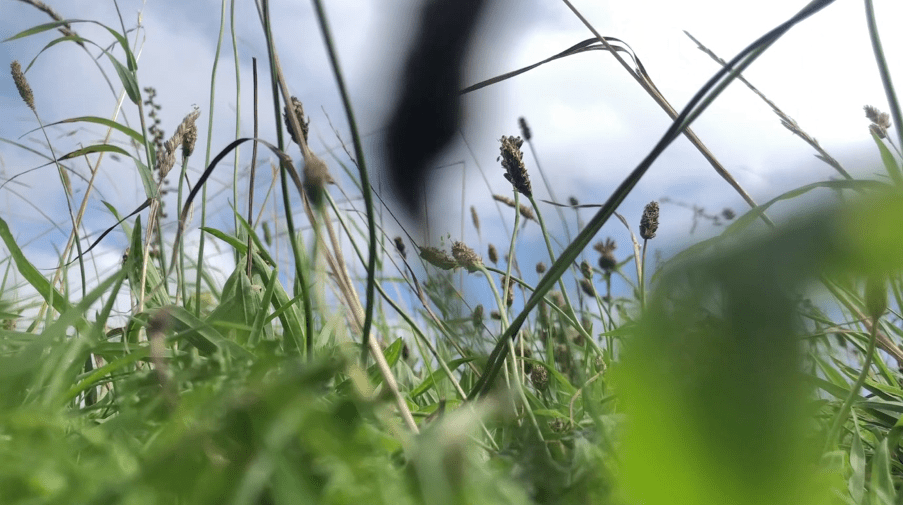
Shirley Chubb, Film Still, Summer, 2023. Photographer: Shirley Chubb
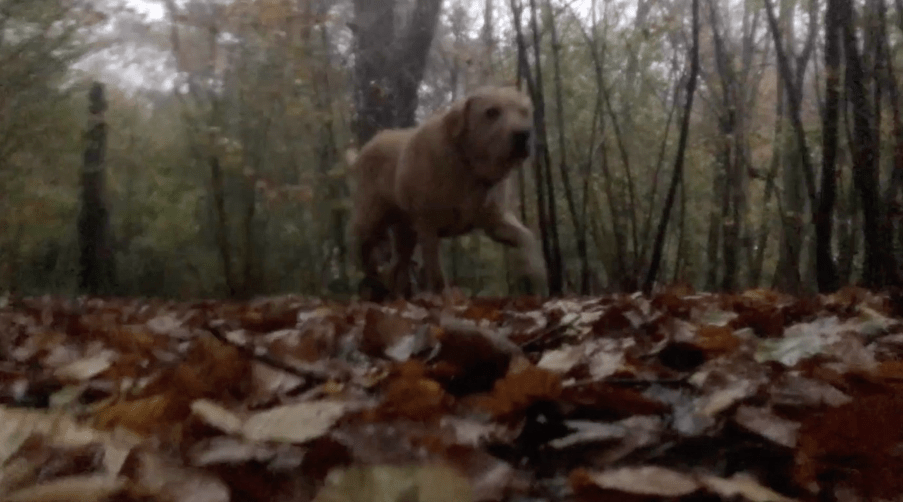
Shirley Chubb, Film Still, Autumn, 2023. Photographer: Shirley Chubb
As our collaborative process grew, walker partners contributed in other ways, for instance partner walker Natalie Sharratt wrote a poem and liaised with Shirley on incorporating this into a film.
She also made key editing decisions in the use of text fonts and colour, and the specific addition of disruptive phases of footage to convey the entanglement of pain and place.
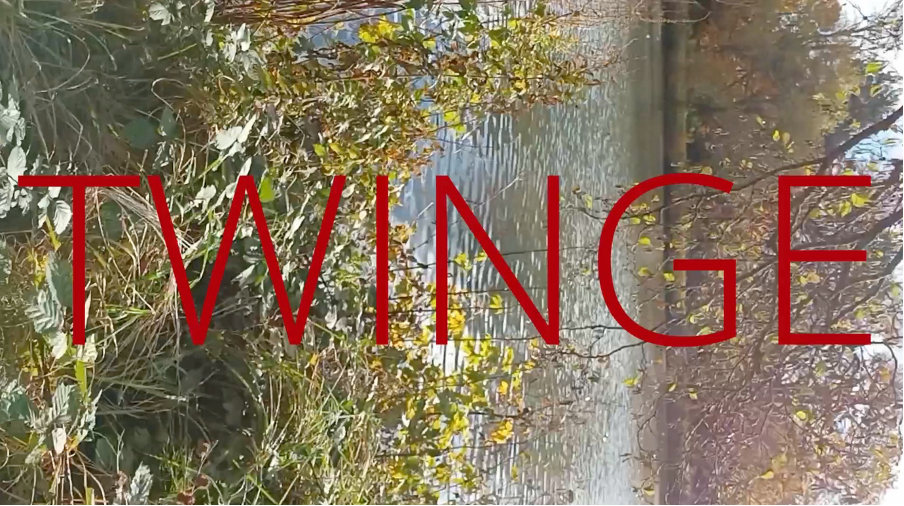
Walker Partner Natalie Sharratt, UK. Project Film Still, 2024
Photographer: Natalie Sharratt
Natalie contributed key editing decisions to reflect the entanglement of pain and walking
Click here to listen to Natalie’s reflections on her experience of taking part in the PWP
Capturing the precise nature of walking experiences indicates how the hybrid creative approach of the project enabled walkers to explore and express the entanglement of walking, pain and landscape in specific locations and seasonal conditions, and points to the ongoing potential of the project methods.

Walker Partner Lena, Norway. Project Film Still Winter, 2023.
Photographer: Lena
Lena first walked in Northern Norway during the polar night season
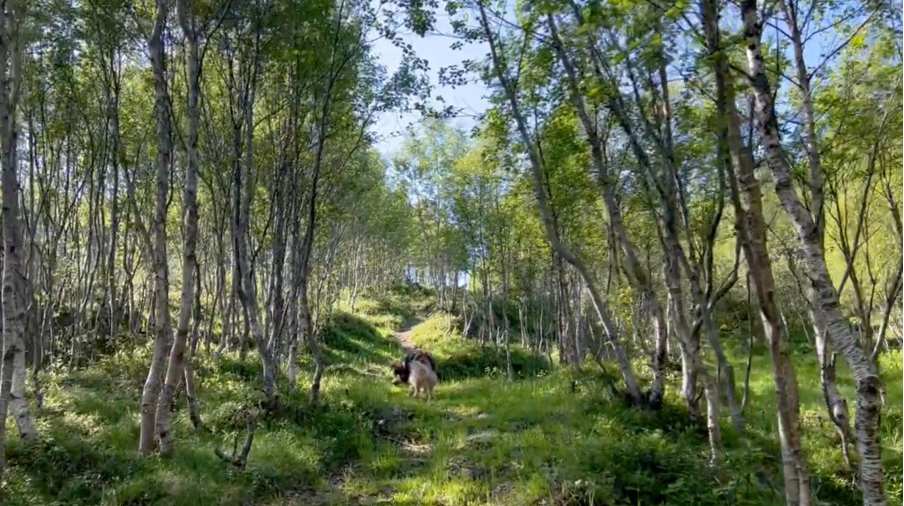
Walker Partner Lena, Norway. Project Film Still Winter, 2023.
Photographer: Lena
Lena then took a second walk in the same environment during the summer
As we began to understand the varied assemblages of walking-pain-culture-place-task-landscape we came to recognise that each environment was encountered as an active collaborator. In the Philippines walkers documented urban locations where the purpose of walking was for transport rather than a leisure activity.
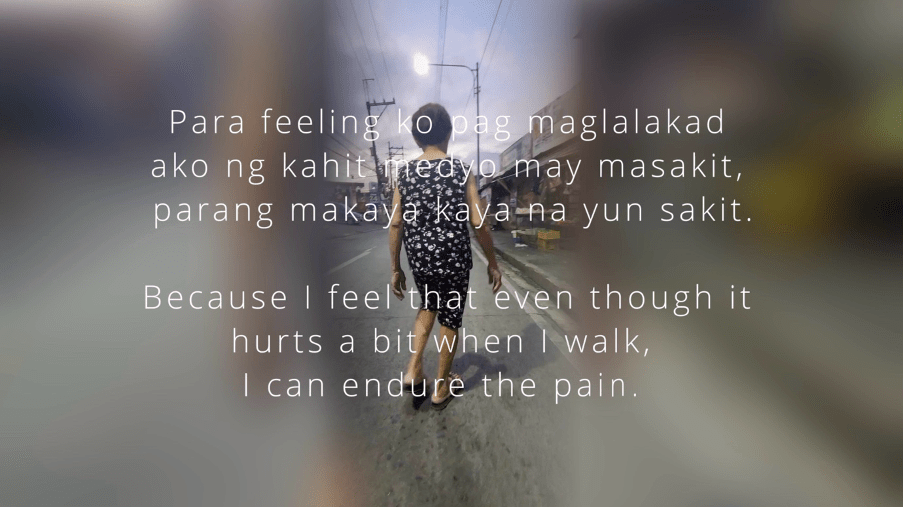
Walker Partner Norma, Philippines. Project Film Still, 2023
Photographer: Valentin C. Dones III
Val documented Norma’s walk to local shops in October at the end of the rainy season
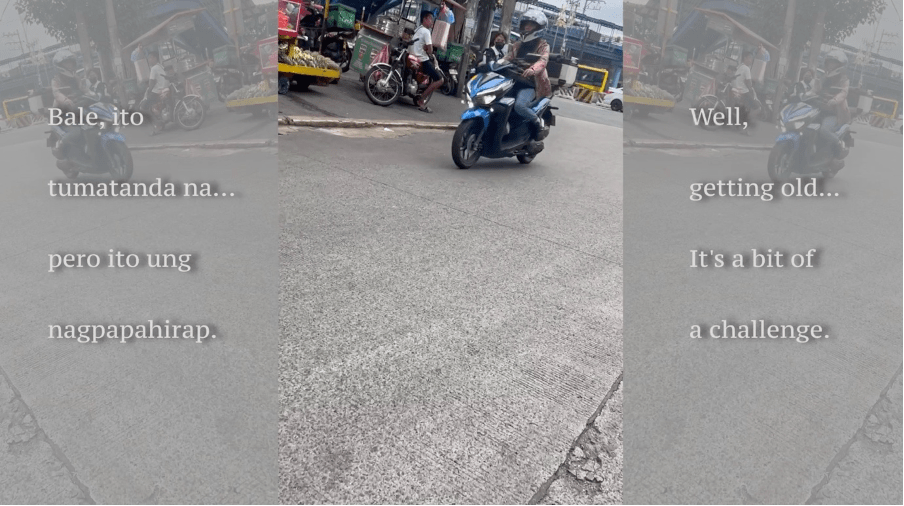
Walker Partner John, Philippines. Project Film Still 2024
Photographer: John
John documented his urban walk from work during the January dry season
These films contrasted with assemblages in the global north, as illuminated by walker-partner Fe who, in one of our meetings, reflected that ‘interestingly I could not bring myself to take an urban walk – I seem to clearly define ‘walking’ as in nature, what I do in urban environments is “getting around”’.
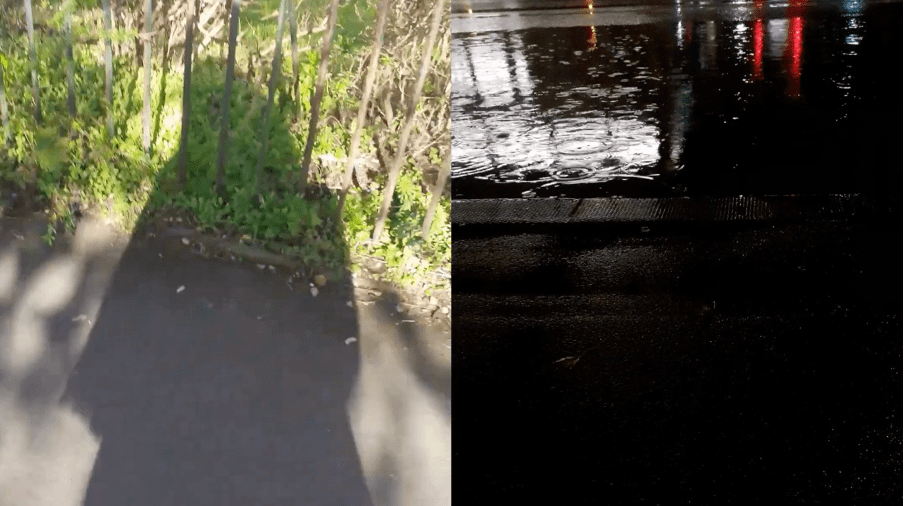
Walker Partner Fe Stevens, UK. Project Film Still, 2024
Photographer: Fe Stevens
Fe captured contrasting urban elements that were very different from her rural walks
The accumulated films and their representation of the multiplicity of walking are the primary findings of our project. Each film captures the growing awareness of individual walkers as they reflect on the sense of partnership they felt with the landscapes they walked in, and the contribution this made to their awareness of pain and wellbeing.
The films are additionally open to the interpretation of those watching, allowing the sense of becoming to continue developing. As such, awareness and reflection continue to emerge and invite response, rather than there being a definitive, finite end to the project.
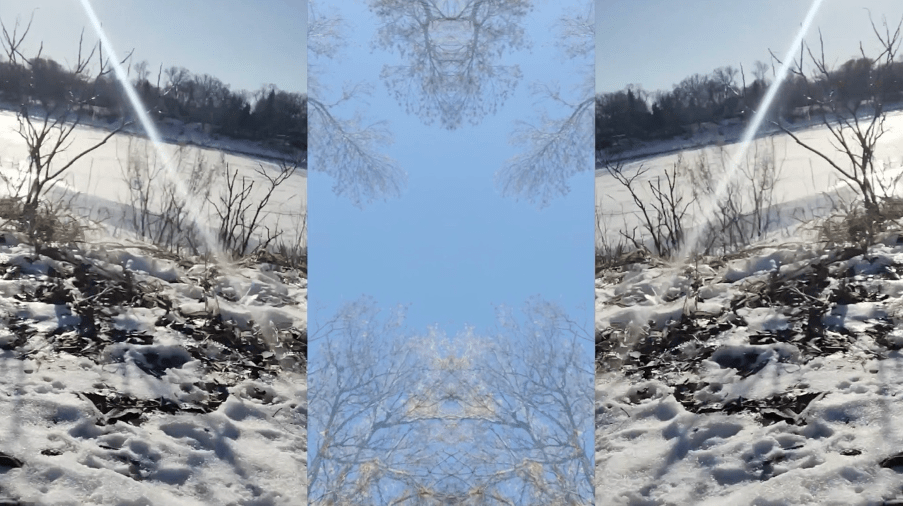
PWP – Walker Partner Jeni Ross, Canada. Project Film Still, 2024
Photographer: Jeni Ross
Jeni captured snow and sky by recording with a mobile phone attached to her leg and viewing upwards during the Canada spring
See Jeni’s reflections on her experience of taking part in the PWP below
“My story with pain, walking, and landscape has certainly not been a linear one. There have been many ups and downs in the last two years since beginning a journey of chronic pain, and it has completely changed how I experience movement and my surroundings.
My neighbourhood, which is where I chose to walk for this project, was an environment in which I used to run, cycle, experience peace by the river and within the treed areas. My relationship with it was forcefully adjusted after an injury two years ago caused me to live in a new body – a body with pain triggered quite easily – and one in which I was not familiar in terms of the consistency of pain.
As this happened during a Winnipeg summer, I still wanted to be outside, and knew I needed to keep moving, as sitting caused stiffness. I would go outside and walk up and down my back lane. Then eventually I would extend this to around the block. Until I finally, after some time, started to feel good enough to extend that to longer walks over a period of quite a few months.
As I would walk through the neighbourhood, I was in a mode of constant comparison to my former bodily experience within my environment. “I used to jog this path instead of walk intentionally.” “I used to walk up this hill instead of avoid it.” “I miss biking up and down this gravel.” I would also be so much more focused on how my body felt, that I found myself less aware of the beauty of my surroundings. It was almost as if the landscape were fuzzy, or as if I were seeing everything through foggy glasses.
Eventually I came to terms with this change (and thankfully have been able to add back some of these activities, but not without some discomfort), and have become more awakened to my surroundings. I am always aware of how far I can walk from one day to the next, which footware will be best, and dependent on the season, how slippery the ground is, as that always affects how I move.
However, although it took work and intentional meditative thoughts, I have been more connected with nature as I move, with noticing things like the sun on my skin, the smell of woodchips, the crunchy leaves under my feet, and the sparkly snow on the ground.
This project has taught me a lesson in how to creatively experience my body within and in relation to my surroundings. I’ve enjoyed experimenting with how to properly capture the feeling of unevenness in the videos I took as I walked, and the juxtaposition the beauty and peacefulness of the prairies.”
Jeni Ross, July 2024
 Posthuman Walking Project